The population of hyper-luminous X-ray sources as seen by XMM-Newton
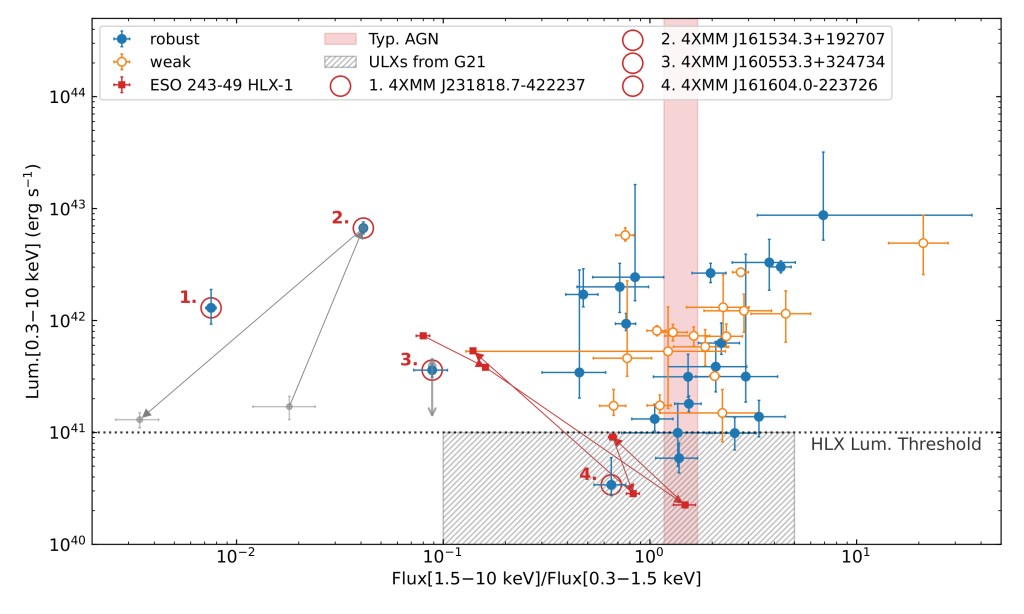
We analysed a sample of hyper-luminous X-ray sources (HLXs) detected by XMM-Newton to investigate their nature and spectral properties. After removing many contaminants (AGNs, diffuse emission, and tidal disruption events), we fitted the remaining 40 spectra with absorbed power-law models to determine luminosities and hardness ratios, enabling the construction of a hardness–luminosity diagram and comparison with the HLX prototype ESO 243-49 HLX-1. The resulting population spans luminosities from 10⁴¹ to nearly 10⁴³ erg s⁻¹ and exhibits a broad range of hardness values. Roughly half of the sources appear harder than typical AGNs, suggesting an extension of the ULX population, while four very soft outliers resemble ESO 243-49 HLX-1, showing steep spectra and strong luminosity variability. We conclude that HLXs are a heterogeneous class, and further observations are needed to constrain the nature of these extreme objects.
The hunt for new pulsating ultraluminous X-ray sources: A clustering approach
(Pinciroli Vago, N.O., Amato, R., et al., 2025)
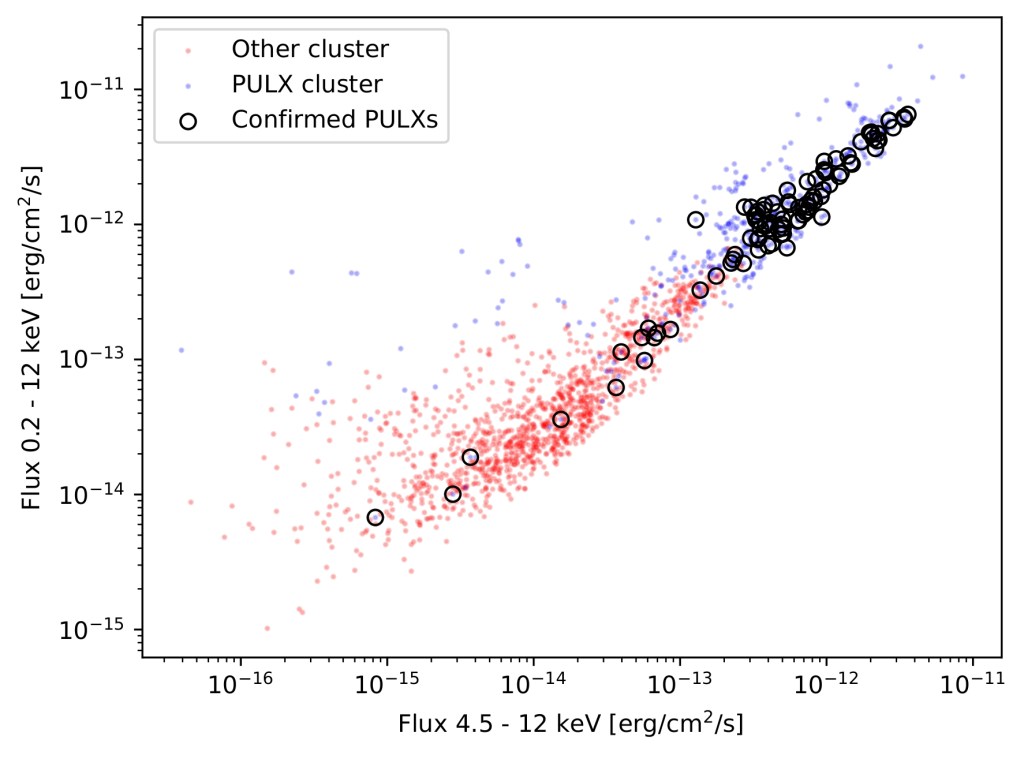
The discovery of pulsations in ultraluminous X-ray sources (ULXs) is often hindered by poor statistics. To identify new candidate pulsating ULXs (PULXs), we applied clustering to an updated XMM-Newton catalogue of 640 ULXs (~1800 observations, including 95 of known PULXs). The method, calibrated on the known PULXs, isolates a cluster of 85 candidate sources, most with multiple detections. Preliminary timing analysis revealed no new pulsations, yet the candidates occupy the same multidimensional parameter space as confirmed PULXs. This work highlights the predictive power of AI-based approaches and identifies promising sources for future searches and observations.
Populations of neutron star ultraluminous X-ray sources: Mind your bs and Bs
(Kovlakas et al., 2025)
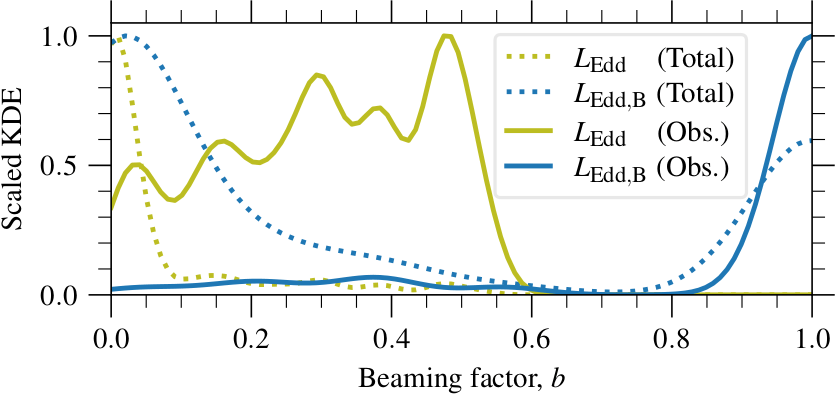
We investigate the effects of strong magnetic fields on neutron star ultraluminous X-ray sources (NS-ULXs) using population synthesis models. The reduction of the Thomson cross-section in the presence of strong magnetic fields allows NS-ULXs to reach super-Eddington luminosities with milder geometrical beaming, broadening the range of spin-up rates and improving agreement with observations. We find that reduced beaming increases the likelihood of observing NS-ULXs within wind-powered nebulae, such as NGC 5907 ULX-1. These results highlight the necessity of including magnetic effects in modeling NS-ULXs and motivate the development of magnetospheric accretion prescriptions suitable for population synthesis codes.
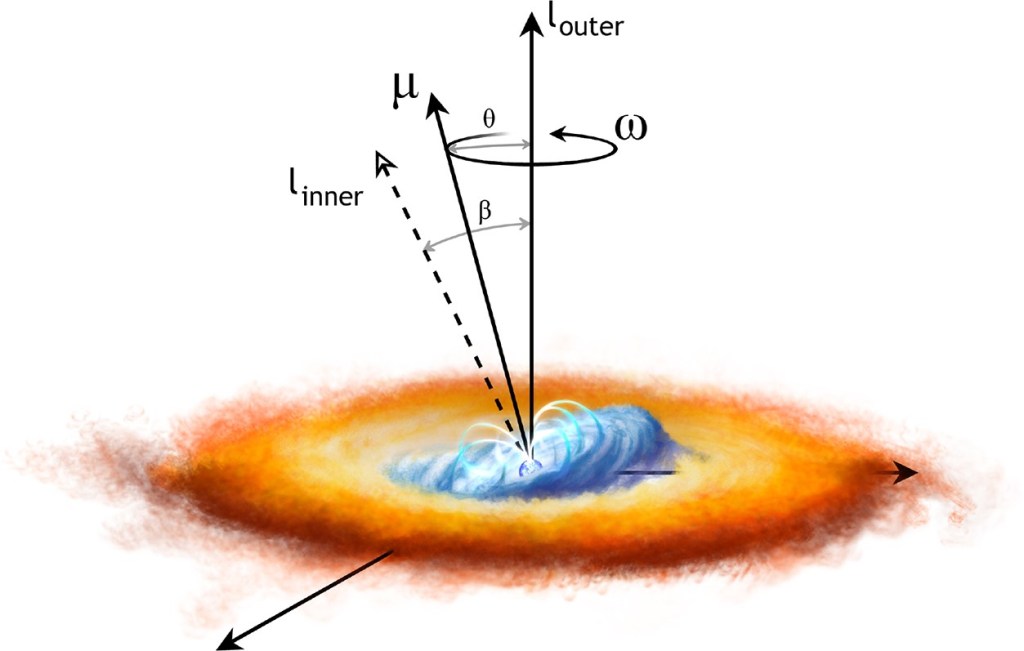
(Credit: Veresvarka et al., 2024)
Wobbling around the clock: magnetically-driven quasi-periodic oscillations in pulsating ultraluminous X-ray sources
(Veresvarska et al., 2025)
Among the few know pulsating ultraluminous X-ray sources (PULXs), only three show coherent signals consistent with neutron star spin periods and mHz quasi-periodic oscillations (QPOs). While QPOs have been linked to general relativistic frame-dragging, we investigate an alternative model in which magnetically driven precession of the inner accretion flow reproduces both spin and QPO frequencies. For a range of parameters, we obtain solutions with accretion rates of ≈10⁻⁷–10⁻⁵ M⊙ yr⁻¹ and magnetic field strengths ≳10¹² G, in agreement with previous estimates. This scenario provides a self-consistent explanation for the observed high luminosities and QPOs of PULXs without requiring relativistic effects or strong beaming. Although parameter degeneracies limit predictive power, the discovery of additional PULXs will be crucial to further test the model.
Skipping a beat: Discovery of persistent quasi-periodic oscillations associated with pulsed fraction drop of the spin signal in M51 ULX-7
(Imbrogno et al., 2024)
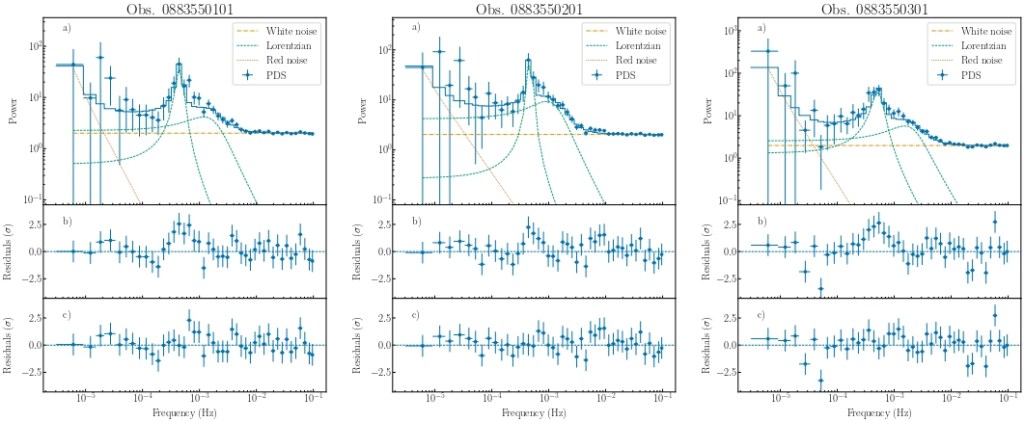
We present timing and spectral analyses of three recent XMM-Newton observations of the pulsating ULX M51 ULX-7 (P ≃ 2.8 s, Porb ≃ 2 d), complemented by archival XMM-Newton, Chandra, and NuSTAR data. We report the recurrent detection of a broad, significant complex at mHz frequencies in the power spectra, also present in 2012 Chandra observations, while the spin signal remains undetected (pulsed fraction ≲10%). These findings demonstrate that mHz quasi-periodic oscillations at super-Eddington luminosities cannot be reliably used to infer the accretor mass. Furthermore, the apparent suppression of spin pulsations by the mechanism producing aperiodic modulation implies that the population of pulsating ULXs may be larger than currently identified.
The ultraluminous X-ray source M81 X-6: a weakly magnetised neutron star with a precessing accretion disc?
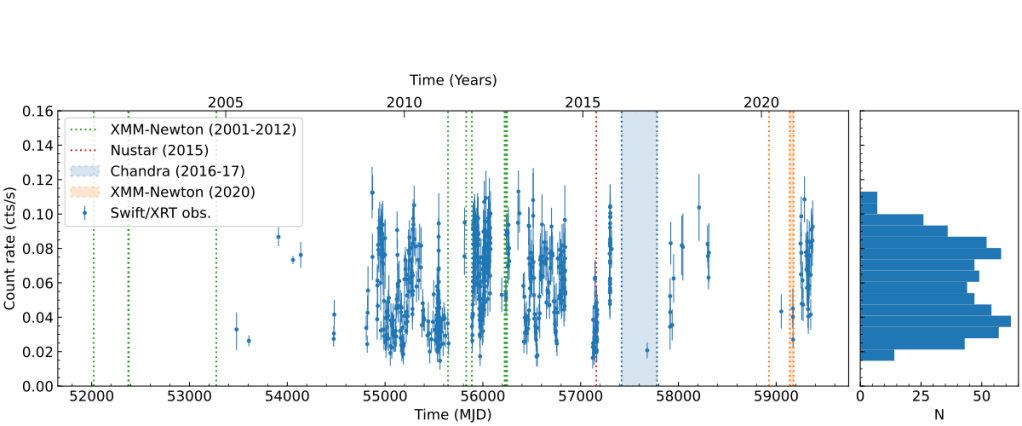
We study the long-term spectral and temporal evolution of the ULX M81 X-6, combining data of several X-ray missions. The source oscillates between two main states, while the soft component remains stable, suggesting spectral changes are not driven by mass-transfer variations. The bi-modal behaviour and super-orbital period are consistent Lense-Thirring precession, which suggests a weakly magnetised neutron star (B≲10¹⁰ G) as the accretor, while scenarios requiring stronger magnetic fields are disfavoured. The low pulsed fraction and hard-component luminosity below typical ULX pulsar values may explain the absence of observed pulsations. We predict a spin period of a few seconds.
Looking through the photoionisation wake: Vela X−1 at φorb ≈ 0.75 with Chandra/HETG
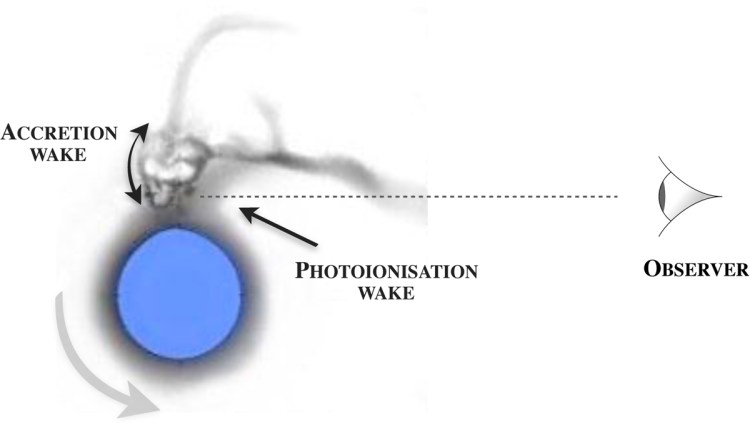
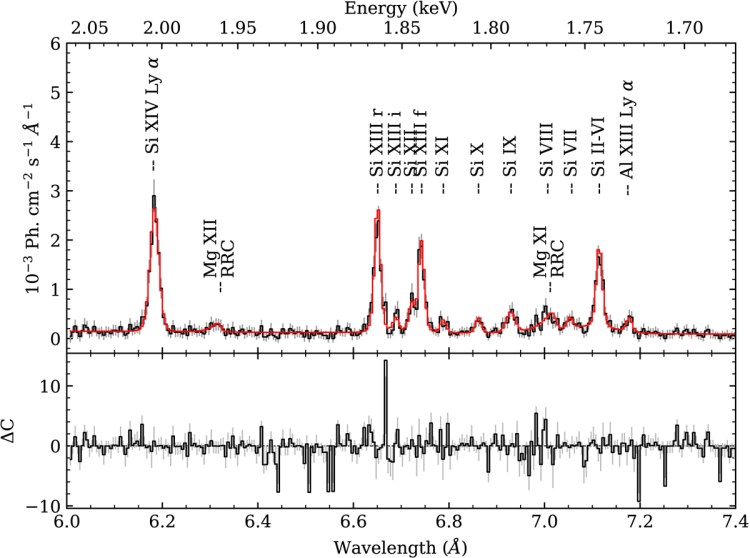
High-resolution Chandra/HETGS spectroscopy of the supergiant X-ray binary Vela X−1 at orbital phase φ≈0.75, crossing the photoionisation wake, reveals multiple emission lines and radiative recombination continua from Fe, S, Si, Mg, Ne, Al, and Na. Using Bayesian analysis and photoionisation models, we demonstrate that the plasma is primarily photoionised with a multi-phase structure, including denser clumps within the hot stellar wind. Simulations with Athena and XRISM indicate that short exposures can resolve key lines, improving the determination of plasma parameters.
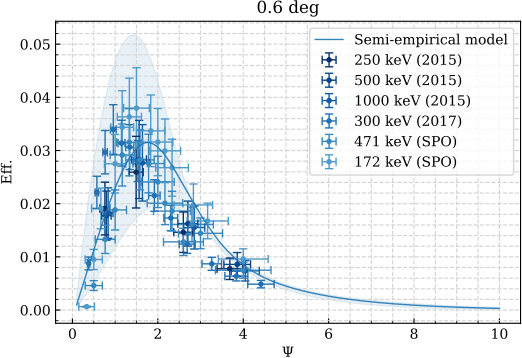
Scattering efficiencies measurements of soft protons at grazing incidence from an Athena Silicon Pore Optics sample
Soft protons pose a risk to X-ray missions with grazing-incidence optics, increasing detector background and potentially causing radiation damage. This is especially relevant for the future ESA mission Athena (now NewAthena), which will have the largest collecting area of all X-ray telescopes built so far. To protect performance, magnetic diverters are planned, whose design relies on understanding proton scattering. In this study, conducted within the EXACRAD project, the scattering efficiency of soft protons on an Athena’s Silicon Pore Optics sample was measured at two energies, ∼470 keV and ∼170 keV, and for angles in the range 0.6°–1.2°. Results align with previous eROSITA measurements, showing peak efficiency near the specular reflection angle.
https://doi.org/10.1007/s10686-020-09657-w
 Dr. Roberta Amato